


SilikonLust
Dragon Phallus Sheath with Ice Dragon Glans Design – Mythic Alien Extender in Nebula Violet
Dragon Phallus Sheath with Ice Dragon Glans Design – Mythic Alien Extender in Nebula Violet
Couldn't load pickup availability
Dragon Phallus Sleeve with Ice Dragon Glans Design & Point-Pressure Penetration
Ancient chronicles describe the Ice Dragon not as an animal. They describe it as a principle: precision over force. Its head—not a rounded dome, but a structure of edges, hollows, and backward-sloping horns—was not made for beauty. It was made for impact. This dragon phallus sleeve is the materialization of this principle in platinum silicone.

Mythical Alien Extender & Dragon Phallus Sleeve: The Dragon Apex as Contact Surface
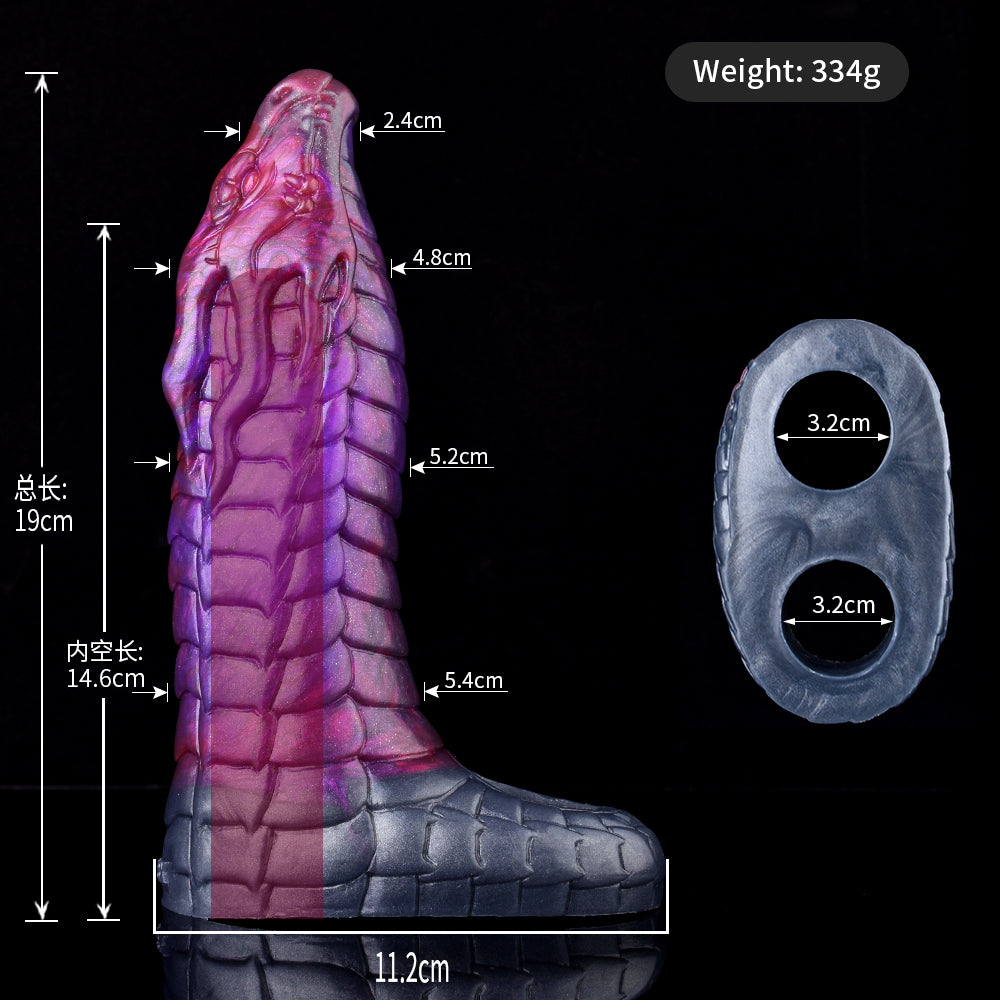
The mythical alien extender begins with a complete dragon head relief: deeply engraved eye sockets, pairs of backward-sloping horn extensions, a closed dragon mouth line with lateral jaw ridges. This geometry does not create a uniform pressure surface during penetration – it creates discrete contact points. Every edge, every hollow, every horn base meets the inner wall at a different point. This is point-pressure penetration: not flat, not even, but precise and unpredictable.
Ice Dragon Glans Design: Three Structural Zones from Apex to Slanted Base
Zone 1 – Dragon Apex: The Ice Dragon Glans design with eye socket relief and horn extension – maximum contact point density, minimum predictability. Zone 2 – Flame Tendon Shaft: Large rhombus scales with engraved flame tendon strands – planar friction that transitions the apex's point pressure into a steady rhythm. Zone 3 – Slanted Base: Matte blue-grey with large square scale segments – no ring, no hole, just an inclined platform that lies laterally against the body and prevents rotation. Three zones. One logic. No compromise.
Nebula Violet & Slanted Base: From the Crimson of the Dragon Creature to the Slate Blue of the Base
The pigmentation follows the anatomy: crimson red concentrates at the dragon apex – where the contact points are densest. Violet with pearlescent particles dominates the flame tendon shaft – vibrant, changing depending on the light. The slanted base remains in matte slate blue – matte, grounded, a thermal counterpoint. Three color zones that mirror three functional zones. No coincidence.

Frequently Asked Questions
What specifically makes point-pressure penetration different from a round head?
A round head distributes entry pressure evenly over a circular area. This apex distributes it to discrete points: eye socket edges, horn base attachments, jaw ridges. Each of these points meets the inner wall at a different place. The result is a pressure profile that changes with every movement – not because the object changes, but because the contact points are positioned differently at each penetration depth.
Is the Ice Dragon Glans design also suitable for beginners?
The dragon apex is narrower than the shaft behind it – entry is gentler than the object's size might suggest. The edge effect of this head profile is noticeable, but not sharp – platinum silicone is yielding. Sufficient lubricant and a slow pace during the first entry are recommended.
How does the slanted base work without a ring or hole?
The slanted base lies against the body as an inclined platform – similar to a wedge that self-fixes under pressure. No ring that constricts. No hole that needs to be positioned. Fixation is achieved through surface contact and the weight of the object itself.
How do I clean the deep eye sockets and horn extension engravings?
Run warm water at slight pressure over the relief surface – the engravings are not porous. A soft brush can help in the deep eye sockets. Mild soap, dry completely. Do not use alcohol-based disinfectants.
Is the color gradient identical on every piece?
The three color zones – crimson red, violet, slate blue – are present in every piece. The exact gradient boundary varies due to the layer-casting process. No two pieces are pixel-perfectly identical.


Latest Sex Toys from SilikonLust
-
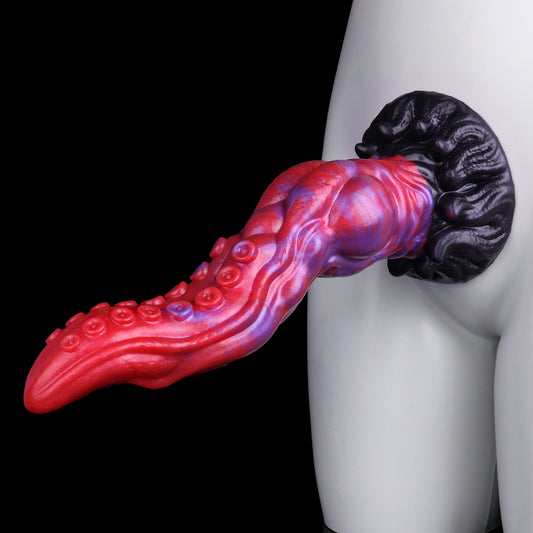
Tentacle Creature Fantasy Dildo - Dual Suction Cup Row Tentacle, Red-Violet-Blue Violet Pearlescent Swirl, Spherical Expansion Zone & Black Organic Tentacle Wreath Suction Cup Base made of Platinum Silicone
Regular price €116,20 EURRegular price -
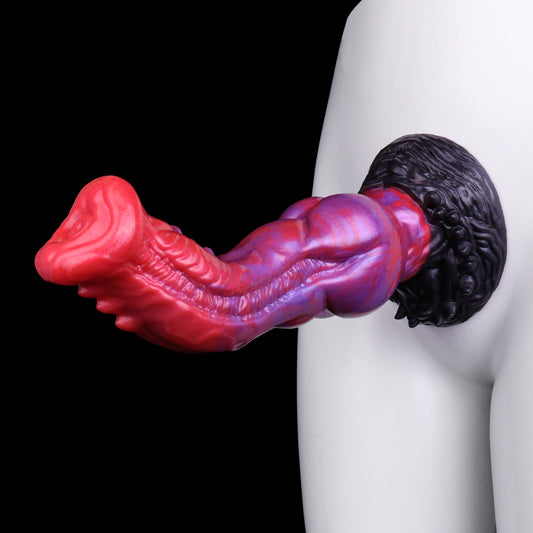
Beast Mouth Dog Dildo - Funnel Rosette Glans, Bilateral Triangular Spike Rows, Double S-Curve Shaft, Ball Expansion Zone & Black Organic Tooth Suction Cup Base Made of Platinum Silicone
Regular price €114,40 EURRegular price -
Scarlet Spiral Dog Dildo – Conical Double-Lip Glans, Beaded Corona Ridge, Screw-Grooved Shaft, Single-Knot Knot Ball & Black Scaled Scrotum Suction Cup Base in Platinum Silicone
Regular price €128,80 EURRegular price -
Dragonpulse Dog Dildo - Radial Blossom Glans, Coarsely Irregular Vein Relief, Dual-Knot Shaft & Black Dragon Scale Testicle Suction Cup Base Made of Platinum Silicone
Regular price €124,60 EURRegular price




Featured SilikonLust Series
-

Buy Squirting Dildo – Cumming Dildo & Squirting Dildo made of Platinum Silicone
Squirting Dildo – When the Moment Is Right A squirting dildo from...
-

Penis sleeve
Platinum Silicone Penis Sleeves – the grip that cheap sleeves never had....


